

Tyre Rotation in Slough
Tyre rotation in Slough from Auto X Limited helps your tyres wear evenly and last longer. Front and rear tyres do different jobs and wear at different rates. By moving them between positions at the right intervals, you spread that wear across the whole set, keep grip balanced front to rear and delay the cost of new tyres.
Looking for tyre rotation near me? Our tyre shop is on Wexham Street, Slough SL3, close to Slough town centre, Langley, Iver, Wexham and Stoke Poges.

What is tyre rotation?
Tyre rotation means moving each tyre to a different position on the car, for example swapping the front tyres to the rear. On most cars the front tyres steer, take most of the braking force and, on front-wheel-drive models, also deliver the power. That makes them wear faster than the rears. Regular tyre rotation evens this out, so all four tyres wear down at a similar rate.
Benefits of tyre rotation
- Longer tyre life. Even wear means the whole set lasts longer before replacement.
- Balanced grip. Similar tread depth front and rear helps the car feel stable, especially in the wet.
- Early problem spotting. Each rotation is a chance to inspect every tyre for damage, nails and uneven wear.
- Replace as a set. When tyres wear evenly, you can replace all four together and keep handling consistent.
How often should tyres be rotated?
A common guide is every 5,000 to 8,000 miles, or at every service or oil change. High-mileage drivers, taxis and delivery vehicles may benefit from more frequent tyre rotation. Always follow the advice in your vehicle handbook, as some manufacturers give their own interval or advise against rotation for certain tyre set-ups.
Tyre rotation patterns
The right pattern depends on the drivetrain and the type of tyre:
- Front-wheel drive: fronts move straight back, and the rears move to the opposite side at the front (forward cross).
- Rear-wheel and four-wheel drive: rears move straight forward, and the fronts move to the opposite side at the rear (rearward cross).
- Directional tyres: tyres stay on the same side and swap front to rear only, because they must roll in one direction.
- Different sizes front and rear: tyres can usually only swap side to side, and only if they are not directional.
What our tyre rotation service includes
- Inspecting each tyre for tread depth, cuts, bulges and embedded objects
- Choosing the correct rotation pattern for your car and tyres
- Moving the wheels to their new positions
- Torquing wheel nuts to the correct setting
- Setting pressures to the recommended figures, adjusting front and rear if they differ
- Resetting the tyre pressure monitoring system where required
Can all cars have tyre rotation?
Not all. Some performance cars and many rear-wheel-drive models use wider tyres at the rear than the front, so the tyres cannot move between axles. Directional tyres can only move front to rear on the same side. A few cars have specific instructions from the manufacturer. We check your car and tyres before starting, and if tyre rotation is not suitable we will explain why and what else can help even out wear.
Tyre rotation in Slough: local driving and wear
Stop-start traffic, roundabouts and tight car parks around Slough put a lot of steering and braking load on front tyres. That means front tyres often wear much faster than the rears for local drivers. Regular tyre rotation in Slough helps balance that out, so you get more miles from every set.
Tyre rotation near me: what to expect
When you visit our shop for tyre rotation, we start with a quick conversation about your car, your mileage and any issues you have noticed. We then raise the car, inspect each tyre, move them to their new positions and set the pressures. Most cars are done in around 30 minutes, and you are welcome to wait.
Tyre rotation and wheel balancing
If you feel a vibration after a tyre rotation, a wheel that was fine at the rear may now be noticeable at the front, where the steering is more sensitive. Wheel balancing will cure this. Many drivers book both together for a smooth ride.
Tyre rotation and wheel alignment
Rotation spreads wear, but it does not fix the cause of uneven wear. If a tyre is wearing on one edge, the car may need wheel alignment. We will point this out during the inspection. If both are needed, we rotate first and then check the alignment.
Reading tyre wear before rotation
- Both edges worn: usually under-inflation
- Centre worn: usually over-inflation
- One edge worn: usually an alignment issue
- Patchy or cupped wear: often balancing or worn suspension
We record what we see so you know the condition of every tyre.
When to replace instead of rotate
If a tyre is close to the 1.6mm legal limit, has a sidewall cut or bulge, or is very old and cracked, it should be replaced rather than moved. We stock budget brands in popular sizes, or you can order online from our budget tyre shop with free mainland UK delivery. Check your size in our tyre size guide.
Should the best tyres go on the front or rear?
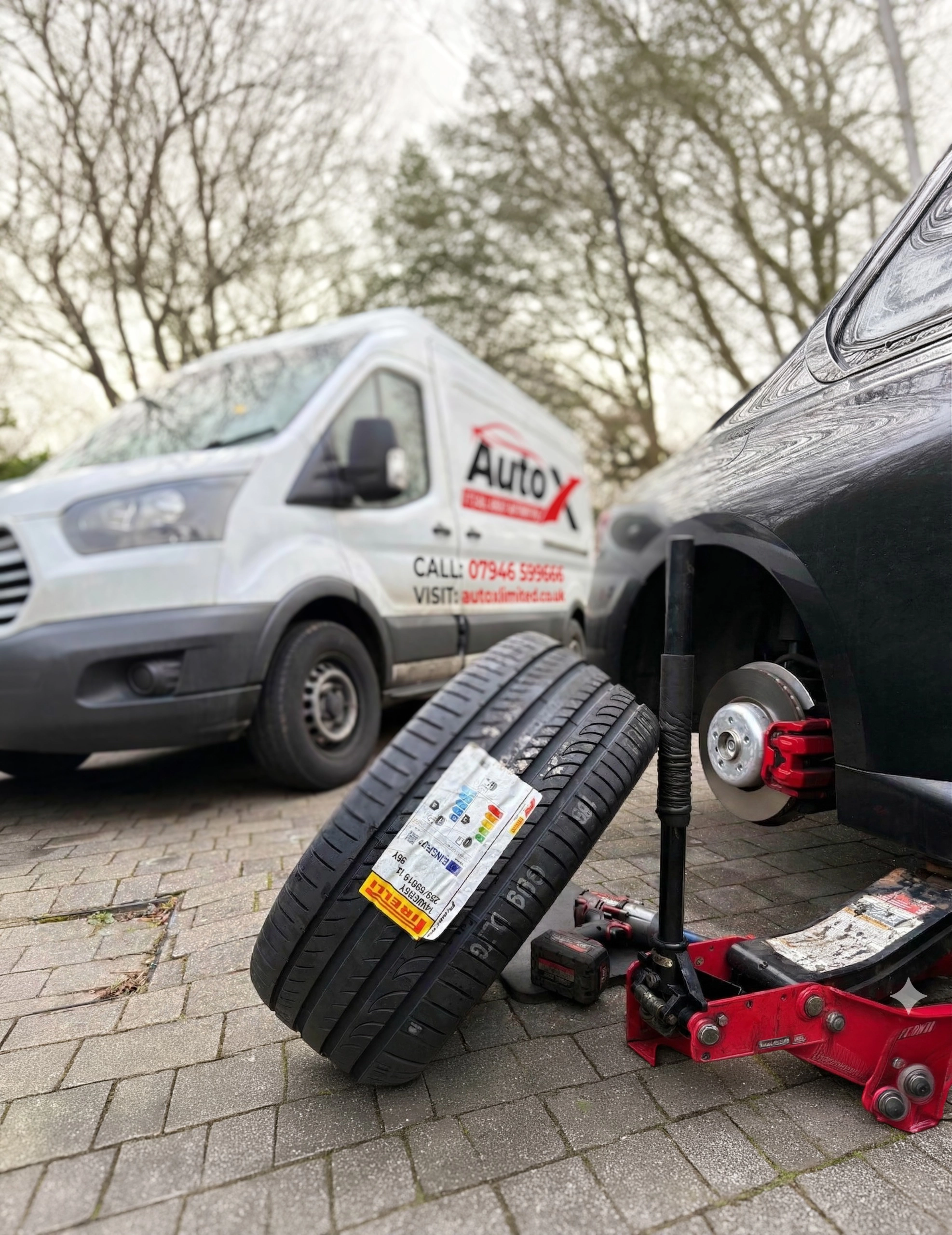
Most tyre makers advise that if you only fit two new tyres, they should go on the rear axle, regardless of which wheels drive the car. Rear tyres with more grip help prevent the back of the car stepping out in the wet. We follow this guidance and will explain it when fitting new tyres alongside a tyre rotation.
Tyre rotation for electric and hybrid cars
Electric and hybrid cars are heavy and have instant torque, which can wear tyres quickly, often on the driven axle. Regular tyre rotation is one of the easiest ways to stretch tyre life on an EV, provided the car uses the same size tyre front and rear. Some EVs also need the pressure monitoring system resetting after rotation, which we can do.
Tyre rotation for vans
Vans carrying heavy loads often wear rear tyres faster than expected, and front tyres suffer on tight urban routes. Tyre rotation helps balance this. Tell us your van and tyre size when booking and we will confirm we can help.
Tyre rotation and the spare wheel
Some older cars have a full-size spare that matches the other four wheels. On these cars, a five-tyre rotation can include the spare, so it is used and does not simply age in the boot. Space-saver spares are not included because they are a different size.
How much does tyre rotation cost?
Tyre rotation is one of the most affordable tyre services, and it can save money by delaying replacements. Call us on 01753 873102 for a clear price before we start.
Keeping track of rotation
Make a note of the mileage each time your tyres are rotated, or keep your receipt with your service history. If you are unsure when it was last done, we can look at the wear on each tyre and give you a sensible recommendation.
Tyre pressures after rotation
Some cars use different pressures front and rear. After a tyre rotation, the pressures must be adjusted to suit each tyre’s new position. We do this as standard, and it is worth checking again a few days later if you have a long journey or a heavy load planned.
Tyre rotation myths
- “It is only for 4x4s.” Most cars benefit, especially front-wheel-drive models.
- “It fixes uneven wear.” It spreads wear, but alignment or balancing fixes the cause.
- “Any pattern will do.” The correct pattern depends on drivetrain and tyre type.
Areas we cover
Drivers visit us for tyre rotation from Slough (SL1, SL2 and SL3), Wexham, Langley, Iver, Stoke Poges, Farnham Common, George Green, Burnham, Datchet and Windsor. We are close to the M4, M40 and M25.
Why front tyres wear faster
Every time you turn the steering wheel, the front tyres scrub slightly across the road surface. When you brake, weight shifts forward and the front tyres do most of the work. On a front-wheel-drive car they also transmit the engine’s power. Rear tyres simply follow along. Over a year of normal driving, the difference in tread depth between front and rear can become significant, which is exactly what rotation is designed to address.
Measuring tread depth
We measure tread depth at several points across each tyre, not just in the middle, because uneven wear can hide on the inner edge. The UK legal minimum for cars is 1.6mm across the central three quarters of the tread. Many safety organisations recommend considering replacement at around 3mm, because grip in the wet drops noticeably as tread wears down.
A simple 20p test
Between visits you can check tread depth yourself. Insert a 20p coin into the main grooves of the tyre. If the outer band of the coin is hidden, the tread is likely above the legal limit. If you can see the band, have the tyre checked as soon as possible. Repeat the test at several points around each tyre and across its width.
Tyre age and the DOT code
Tyres age even when they are not used much. The four-digit code on the sidewall shows when the tyre was made, for example 1824 means week 18 of 2024. Older tyres can harden and crack, which reduces grip. When we inspect your tyres, we also look at their age and will tell you if any are showing signs of deterioration.
Matching tyres across the car
For predictable handling, tyres on the same axle should be the same size, construction and, ideally, the same pattern. Mixing very different tyres front and rear can upset the balance of the car. If you are replacing tyres, our team can help you choose sensible options from our range so the whole car works together.
What happens if tyres are never moved?
Without rotation, the front tyres of most cars wear out first and are replaced in pairs, while the rears keep ageing. Over time you end up with a mix of new and old tyres with different grip levels. Rotating the set keeps tread depths similar and lets you plan a single replacement of all four, which keeps the car balanced.
Combining services in one visit
Rotation, pressure checks, balancing and alignment all fit naturally into one appointment. Doing them together saves you a second trip and gives us the full picture of how your tyres are wearing. Let us know what you would like when you call, and we will allow enough time.
Fleet and business vehicles
Taxis, couriers and trades vans around Slough and Heathrow cover high mileage on busy roads. Regular rotation can extend tyre life across a fleet and reduce downtime. If you look after several vehicles, call us to arrange a convenient schedule.
Seasonal checks
Before winter, good tread depth matters most because roads are wet and cold. Many drivers combine a rotation with an autumn tyre check so the deepest tread is on the axle that needs it. Before long summer trips, a check of pressures and condition helps avoid problems on the motorway.
Our promise
We only recommend work your car needs. If rotation is not suitable for your tyres, or your wear is already even, we will tell you. If we see a problem such as a nail or a damaged sidewall, we will show you and explain the options before doing anything else.
Before you visit
- Bring your locking wheel nut key if your car has one
- Tell us if your car has directional or different-sized tyres
- Let us know when the tyres were last moved, if you know
- Mention any vibration, pulling or noises you have noticed
Tyre rotation and run-flat tyres
Run-flat tyres have stiff sidewalls and are common on some premium cars. If your car uses the same size run-flats front and rear, tyre rotation is usually possible and helps even out wear on these expensive tyres. Tell us when you book, as we take extra care when handling run-flats.
Tyre rotation and winter or all season tyres
All season and winter tyres benefit from tyre rotation just like summer tyres. If you keep a separate set of wheels for winter, label each wheel with its position when you remove it. That way the next fitting can include a rotation, so each set wears evenly over the years.
Pressure monitoring sensors
Many modern cars have sensors inside each wheel that report tyre pressure. Some systems learn the position of each wheel and need a reset or relearn after the wheels are moved. We check this as part of the job, so you do not drive away with a warning light or incorrect position readings on your dashboard.
Wheel nut torque matters
When wheels are removed and refitted, the nuts or bolts must be tightened to the correct torque in the right sequence. Over-tightening can damage threads and warp brake discs. Under-tightening can let the wheel loosen. We torque every wheel to the specification for your car and recommend having them re-checked after around 50 miles if you are unsure.
Noise after rotation?
Occasionally a tyre that has worn in one position makes a little more noise when moved to another, until its wear pattern settles. This is normal and usually fades within a few hundred miles. If a new noise or vibration persists, come back and we will check the car.
Caravans, trailers and heavy loads
Towing or carrying heavy loads shifts weight onto the rear tyres and can change how quickly they wear. If you tow regularly, keep pressures at the laden figures in your handbook and ask us to look at wear across the set during your visit. We will suggest a sensible interval for your type of driving and let you know if anything needs attention.
Book tyre rotation in Slough
Our tyre shop on Wexham Street, Slough is open 9am to 6pm. Call 01753 873102 to book or WhatsApp 07946 599666.
Why rotate your tyres with Auto X Limited
Longer tyre life
Even wear means you replace tyres less often.
Balanced grip
Similar tread front and rear helps handling.
Full tyre check
We inspect tread, sidewalls and pressures every time.
Local Slough tyre shop
Open 9am to 6pm on Wexham Street.
Tyre rotation FAQs
Yes. On most front-wheel-drive cars the front tyres wear faster. Rotating them evens out wear across the set.
Not all. Cars with different sized tyres front and rear, or some directional tyres, have restrictions. We will check before we start.
Usually around 30 minutes.
If both are needed, we rotate first and then check alignment.
Every 5,000 to 8,000 miles or at every service is a good guide. Check your handbook too.
Our tyre shop is on Wexham Street, Slough SL3, open 9am to 6pm. Call 01753 873102.
Related services
- Wheel Balancing
- Wheel Alignment
- Puncture Repair
- 24/7 Mobile Tyre Fitting
- Buy Budget Tyres Online
- Tyre Size Guide
Find us on Google: read our customer reviews and get directions to our base at Twin Trees Farm, Rowley Lane, Wexham Street, Slough SL3 6PB on our Google Business Profile.
Get in Touch for Tyre Rotation
Areas We Cover
From our yard at Twin Trees Farm, Rowley Lane, Wexham Street, Slough SL3 6PB, we provide 24/7 car recovery, towing, roadside assistance, and mobile tyre fitting across Berkshire, Buckinghamshire, Surrey, West London, and Hertfordshire. Choose your area to see local roads, services, and FAQs.
Buckinghamshire
Hertfordshire
Not sure if we cover you? Call 07946 599666 or 01753 873102, or find us on Google Maps.